Hermanus is unusual among South African coastal towns, and the reason is simple enough to check on a map: the view here faces south, and the sun comes from the north. The best glass in the house therefore sits on the one wall that barely sees a direct sunbeam from March to September — which changes almost everything about what should be hanging in it. This is a free field guide to that peculiarity, written for the months when this town does most of its looking out of the window.
Hermanus sits on the northern shore of Walker Bay, on the Overberg coast, with the Kleinrivier mountains and the Fernkloof Nature Reserve rising directly behind the town and the bay opening away to the south.1 The Cliff Path runs along that southern edge, and the Old Harbour below it — declared a national monument in 1970 and today a Provincial Heritage Site — is the oldest built thing in the town.2
Read that as a compass instruction rather than a tourist description and the whole shading brief falls out of it. Every house here that was built for the view is glazed to the south. And in the southern hemisphere, the sun is in the north.
The arithmetic is worth doing once, because it settles arguments. Hermanus sits at roughly 34.4 degrees south.1 Run that through the standard solar geometry and at the June solstice the midday sun stands only about 32 degrees above the horizon, due north; at the December solstice it reaches about 79 degrees, almost overhead. In June the sun rises around a bearing of 61 — north of east, over the Kleinrivier valley — and sets around 299, north of west, behind the mountains. In December it rises near 119 and sets near 241, which from here means it comes up out of the eastern arm of Walker Bay and goes down into the mouth of it.
Those four numbers are our own working from the town's published latitude, not a survey. They are easy to check and they are the reason this guide is organised by wall rather than by room.
For half the year the sun spends its entire day over the mountains behind you. Your bay window never sees it once.
Two
The bounce, and why dark fabric sees better than pale
So a south-facing Hermanus window gets almost no direct beam for most of the year. People conclude from this that it does not need a blind. Then they sit in the room on a bright, still morning in September and cannot see the water properly, and they cannot work out why.
What is happening is not heat, it is contrast. The southern half of the sky is bright, and the bay underneath it is a large, moving, reflective surface throwing that brightness back up at the glass. The eye adapts to the brightest thing in its field, which is the water, and everything inside the room goes dim; look the other way and the room's own reflection is laid over the view like a film. Nothing in that chain is solved by a heavier curtain. It is solved by taking the top off the brightness while leaving the picture intact.
Which brings up the one piece of fabric advice most people here get backwards. On a view window, a dark sunscreen sees out better than a pale one. A light-coloured mesh reflects daylight, and a good deal of it reflects back into the room, veiling the very view you hung it for. A charcoal, bronze or deep grey mesh absorbs that light instead, so the weave disappears and the horizon stays sharp. Pale fabric wins on heat rejection; dark fabric wins on view-through. On the bay side of a Hermanus house, where the heat load is small and the view is the whole point, dark is usually the right trade.
What we would fit on the bay side
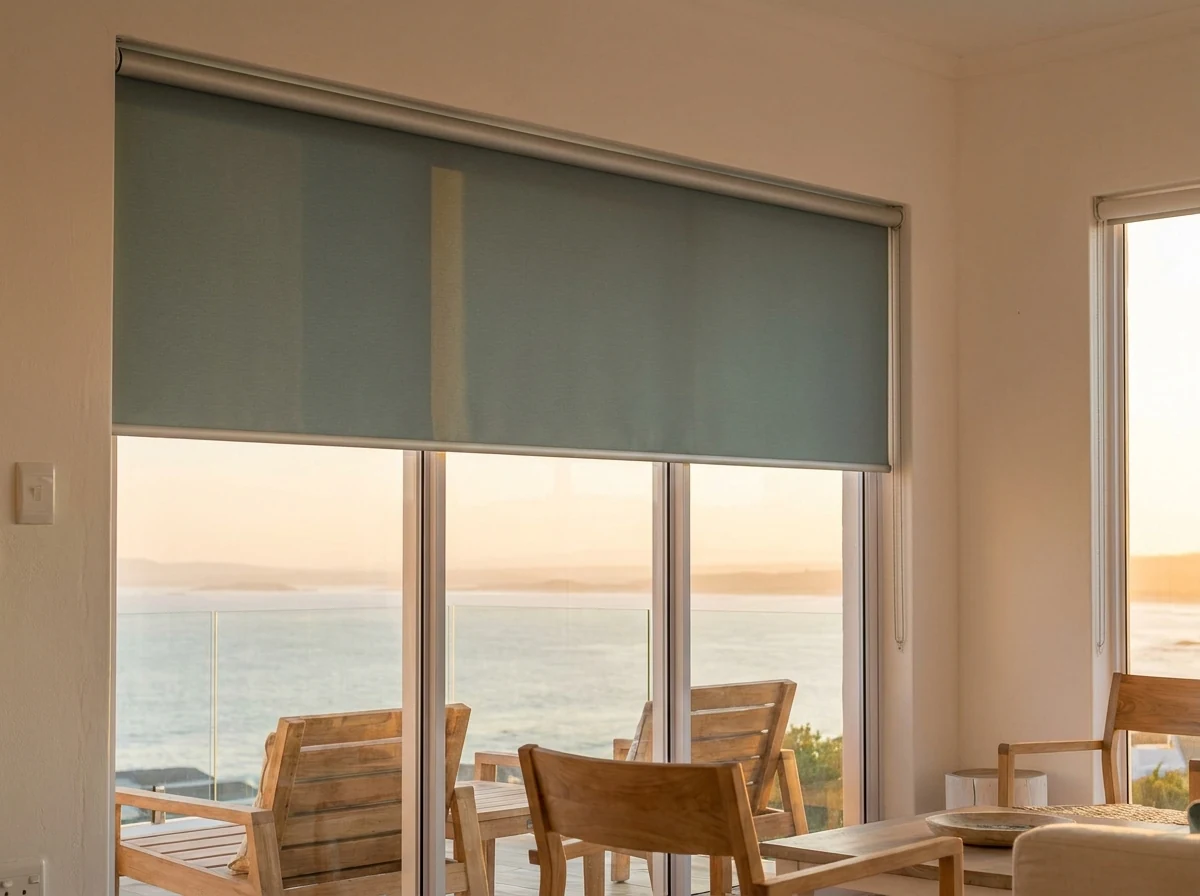
Sunscreen roller blinds at 3–5% openness, in a dark tone on the room side, across the south and south-east glass. Openness is the percentage of the weave that is actually hole: lower blocks more and shows less, higher shows more and blocks less. Three to five per cent is the band where a Walker Bay horizon stays legible.
A second, blockout layer only where the room genuinely needs it. A double roller carries mesh in front and blockout behind on one bracket, so a lounge that watches the water by day can still be shut down at night without a second set of fixings.
Being straight about it: no fabric removes glare and keeps a perfect view at the same time. Every mesh is a compromise between the two, and the right point on that scale differs between a north-lit study and a cliff-edge lounge in the same house.
Halfway down on a bay-facing Voëlklip window — the weave takes the top off the brightness without deleting the horizon behind it.Three
The wall nobody glazed
The north elevation of a Hermanus house is usually the street side, the driveway side, the side with the bathroom window and the kitchen above the sink. It is also, as section one established, the only wall the sun works on for most of the year.
In winter that is a gift and we would ask you not to throw it away. A midday sun at 32 degrees comes in through a north window at a shallow angle and reaches a long way into the room — two to three metres of floor is normal — and that is free warmth in a town where the winter is damp rather than freezing. Blocking it permanently to solve a two-week problem in February is the commonest over-specification we are called in to unpick.
In summer the same window behaves completely differently, because a sun at 79 degrees is falling almost vertically. An eave or a first-floor balcony 600mm deep will shade a north window through the middle of the day in January and not touch it at all in June. Go and look at what your own overhang does at noon in each season before deciding anything about that wall.
Where the north wall does need help
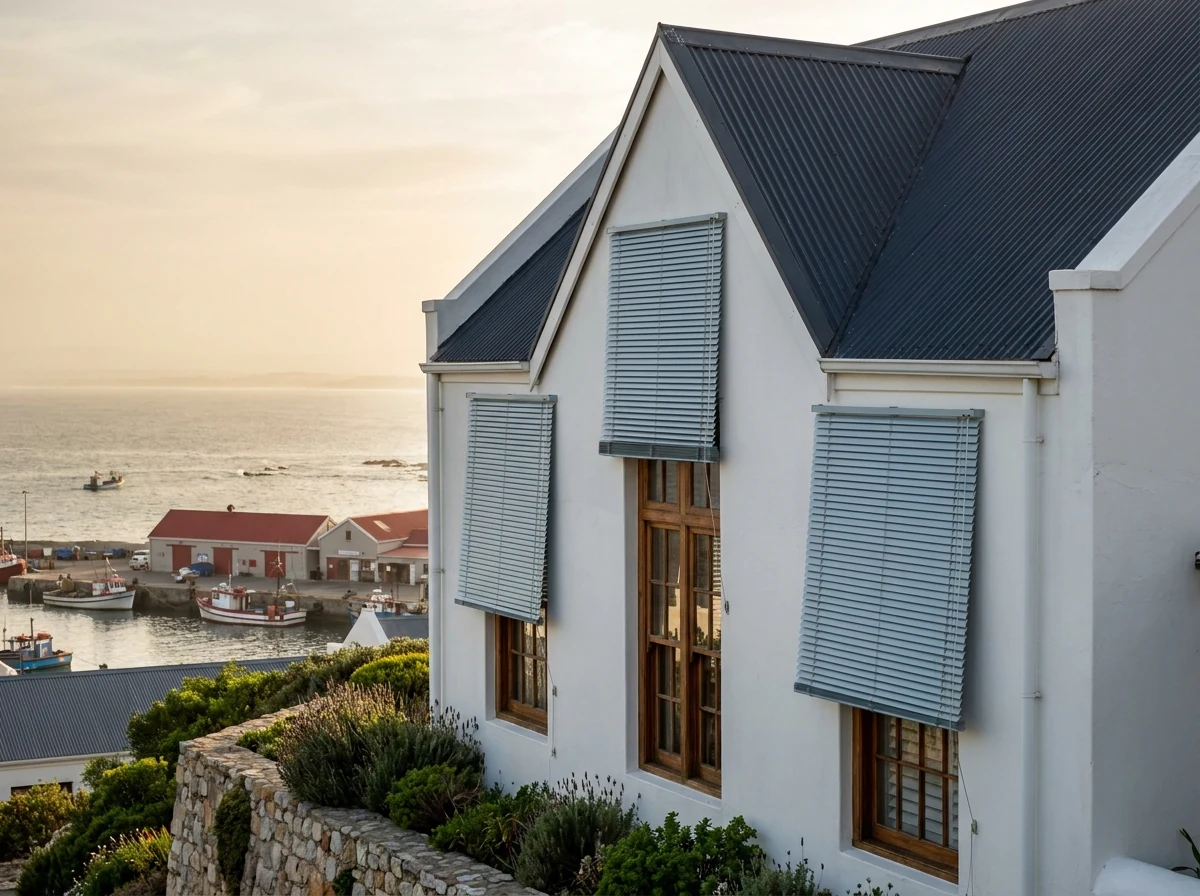
Newer builds on the ridge and in Sandbaai often have no eave to speak of — a flat parapet and a big north window. That is the case for external venetian blinds, and it is the neatest answer we know to a two-season problem: the slats tilt, so you can hold the low winter sun in and push the high summer sun out on the same window, on the same day, without changing anything.
Mounted outside the pane, tilting rather than dropping — the one product that can be told to admit June and refuse January.Four
From November, the west corner
Everything above is comfortable. This section is the part of a Hermanus house that actually cooks.
At midsummer the sun sets on a bearing near 241 degrees — well south of west — which puts the last two hours of the day low over the open water at the mouth of Walker Bay. Any glass on a west or south-west elevation takes that beam straight on, at eye height, plus a second helping of it bounced off the sea. A room can be perfectly pleasant at three o'clock and unusable at six. It is a short problem, four months of the year, and while it lasts it is the only one worth spending money on.
Physics picks the product here, not the price list. Once a beam has crossed the pane its energy is inside the room; an interior blind can only soak it up and hand it back a little later, warming itself and the glass on the way. Catching the same beam before it reaches the pane is a different mechanism altogether, and it is the only one that leaves the glass cool. Which is why the premium end of what we fit in this town hangs on the outside wall.
The premium answer, in order of how exposed the wall is
External venetian blinds where the view matters and the wall is not fully in the weather. Tilting slats outside the pane deflect the beam and keep the sightline, and they retract right out of the way for the eight months you want the light.
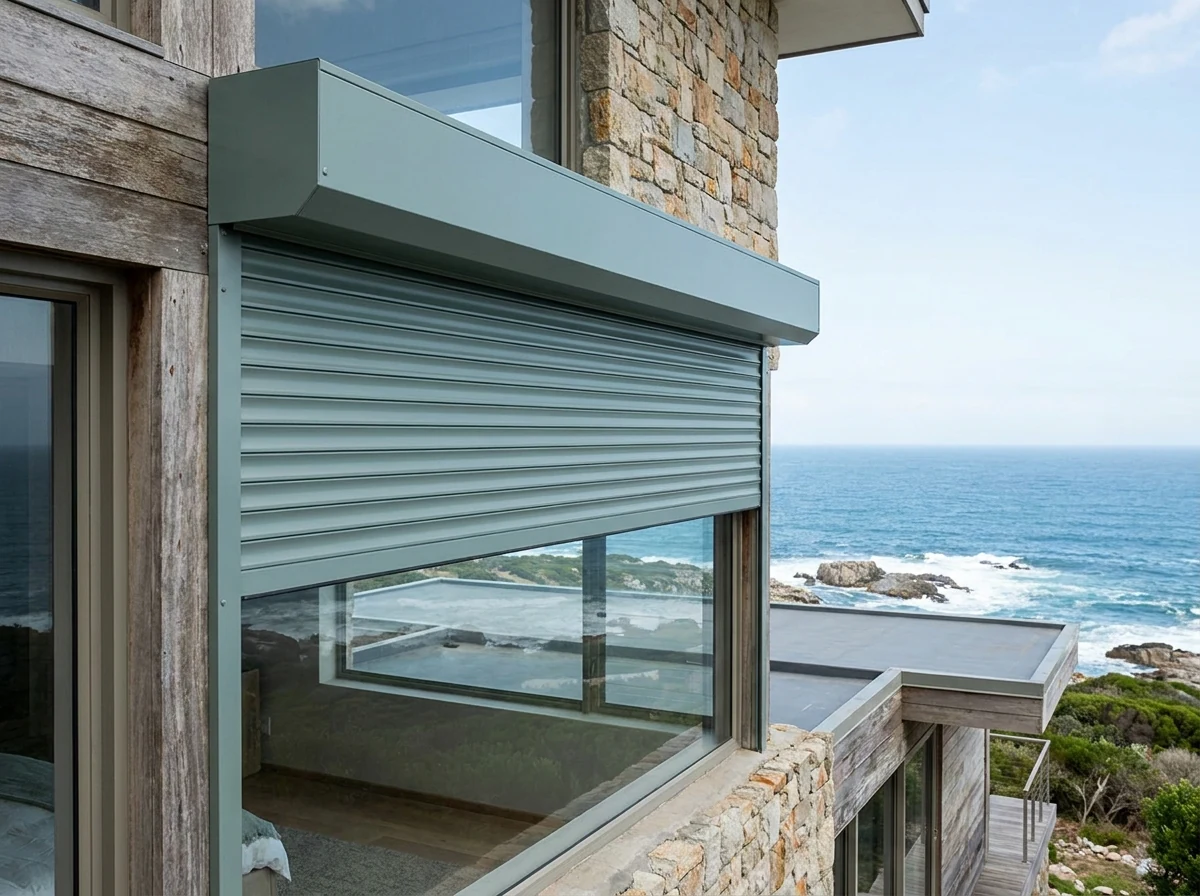
External roller shutters where the room wants more — rigid slats closing down over the opening, cutting the heat hard and adding an insulating air gap on a cold night. Said clearly, because the word gets used loosely in this trade: what we fit controls sun, heat and glare on the outside of the pane and carries no security rating at all. If keeping people out is the actual requirement, that is a different product on a different quote.
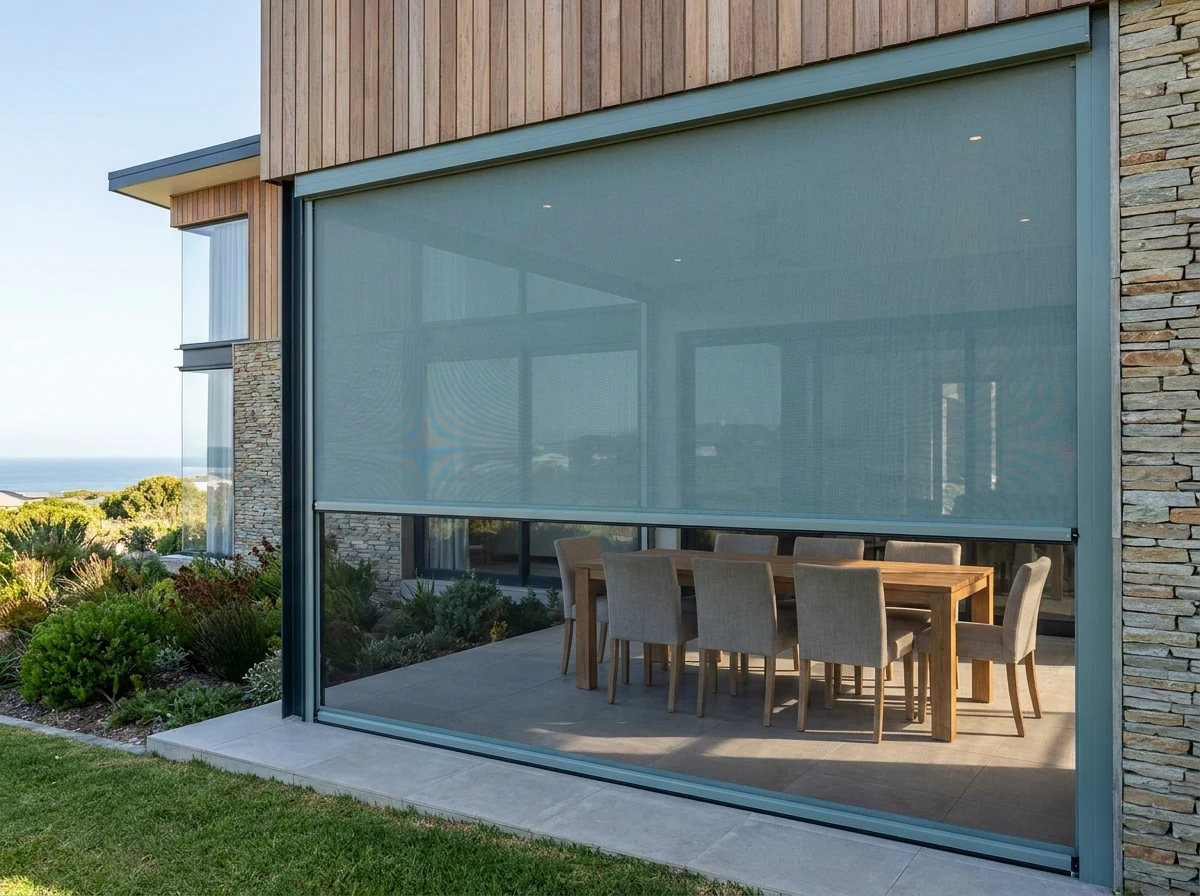
Zip screens for the stoep, the deck and any veranda you actually want to sit on. The mesh runs under tension in aluminium side channels, so it holds where an open-armed awning would be folding, and it turns a windy afternoon deck into a room.
The catch, honestly: all three bolt to the outside of the building. That costs more, it needs a sound substrate to fix into, it puts a mechanism into salt air, and on a heritage or estate property it may need permission first. Where none of it can be arranged, a tightly woven sunscreen behind the pane is the fair second choice: far cheaper, and noticeably weaker against heat. We would rather put it that way than pretend the two are equivalent.
Guide rails down each side of the opening and the slat curtain part-dropped — the summer sun stopped a pane's width short of the room.Five
Two kinds of building in one small town
Walk from the Old Harbour up to the ridge and you pass through two entirely different construction eras in about fifteen minutes, and they want opposite things.
The old core
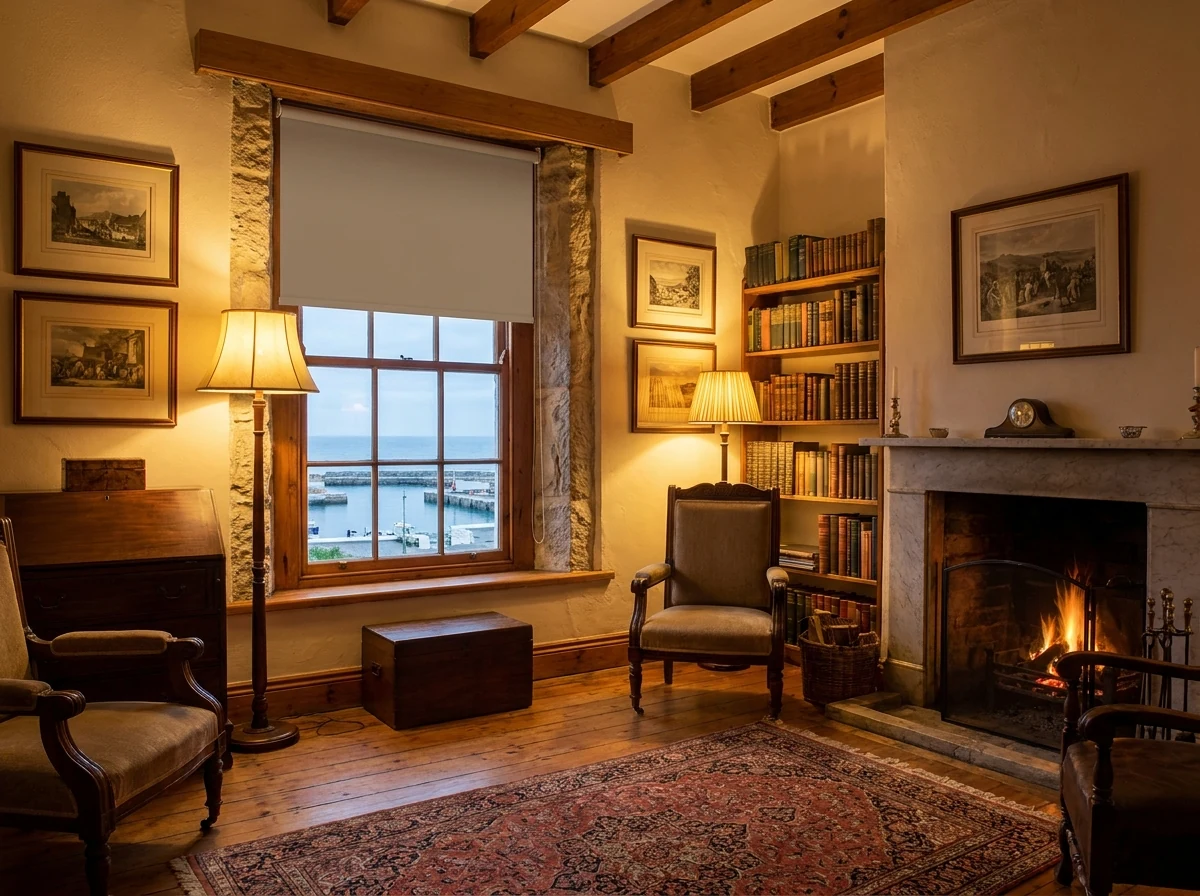
Down near the harbour and along the older streets, openings are small, deep-set and often original. The reveal is the whole opportunity: a blind mounted inside it sits in shadow, touches no external fabric and looks like it was always there. It is also, in legal terms, the quiet option. The National Heritage Resources Act draws its line at sixty years of age. Cross it, and you need a permit from the provincial heritage authority — Heritage Western Cape in this province — before altering the building or any part of it3 — and the Old Harbour precinct carries its own protection on top of that.2 A blind in a reveal alters nothing. A headbox, guide rail or cassette bolted to the outside face of an old wall is a different conversation, and it belongs before the order rather than after the delivery.
The new glass
On the cliff line and up on the Hemel-en-Aarde Ridge the problem inverts: sliding walls of frameless glass, no reveal to hide in, and a designer who does not want to see a headbox. That is what recessed and concealed installations are for — the roller lives in a slot in the ceiling and the fabric appears out of a shadow line. It has to be planned while the ceiling is still open, so if you are building, this is the one decision worth making early rather than at handover. Several of the ridge estates also run their own aesthetics committees, and their rules can be stricter about what shows from outside than any heritage authority.
Inside the reveal of an old harbour-side cottage — nothing fixed to the outside face, nothing to ask permission for.Six
Salt, and the maintenance nobody mentions at the quote
This town is genuinely on the water, and salt aerosol carries inland on a blow. It does not attack blinds so much as it attacks the small metal parts that make blinds work: brackets, fasteners, chain, the end caps of a cassette, the moving joints of an awning arm.
Our standard here is powder-coated aluminium on anything outdoors, sealed cassettes, and fixings specified for a marine atmosphere rather than for the cheapest line on a quote. What we will also tell you, which is less pleasant to hear, is that no coating makes maintenance unnecessary within sight of surf. On an exposed elevation an occasional rinse with fresh water — a hosepipe, not a pressure washer — does more for the life of exterior hardware than any upgrade on the quote, and it matters most after a hard blow, when the salt film goes on thickest.
Marine-grade fixings still mark. Good stainless in a salt atmosphere can develop a brown surface bloom. It is cosmetic and it wipes off; it is not the bracket failing.
The motor is the expensive part. Where a run of glass has a sheltered end, we put the drive there. Where it does not, the cassette seal and the cable entry are worth paying attention to.
Inside is not exempt in a house that spends summer with every door open. Aluminium above a kitchen sink or in a bathroom shrugs the damp off; timber in the same position will bow and stain, and no care undoes it.
Seven
What a wind rating is actually telling you
Hermanus takes the summer south-easter and the winter north-westerly fronts without much between it and either, and outdoor shading gets sold here on wind ratings. It is worth understanding what one of those ratings means before you rely on it.
A wind class is a property of a particular product at a particular size, correctly installed into sound substrate. Three things quietly cancel it. Make the awning wider or the projection longer and the loads rise steeply. Fix it into cracked plaster, a rotten fascia or a thin fibre-cement soffit and the rating describes a piece of hardware that is no longer really attached to the building. And leave it out unattended, in which case the rating is a laboratory number and the weather is not in a laboratory.
Which leads to two things we insist on for any exterior job in this town, and will not be argued out of:
An automatic wind sensor on anything that projects. A sensor retracts the awning before the gust rather than after the damage, and it works when the house is empty, which is when the damage usually happens.
Channel-guided beats arm-supported when the elevation is exposed. A zip screen held in side channels transfers load into the building along its whole height. A folding-arm awning holds it in two elbows. Both have their place; on a cliff-facing deck the difference is not subtle.
Held in channels down both edges rather than hanging free — the reason a zip screen still behaves on an afternoon that has folded the neighbour's umbrella.Eight
A house that fills up in winter
Most South African coastal towns are busiest in December. Hermanus has a second season that runs against that grain: southern right whales are in Walker Bay from around June to December, with the best of it from August to October, and the town is known for watching them from the land rather than from a boat.14
That single fact changes the brief for a front room here. The months when this house does most of its living are the cold, bright, damp ones — the months when the sun is on the wrong wall, when the sea is grey and glaring at the same time, and when a family sits still, indoors, looking out for a long time at a small distant thing. A room specified for a December sunroom will fail all of that.
What a winter-watching room wants
See-through glazing dressing, not blockout, on the bay side. Section two covers the fabric; the discipline is simply not to let a bedroom decision creep into a lounge.
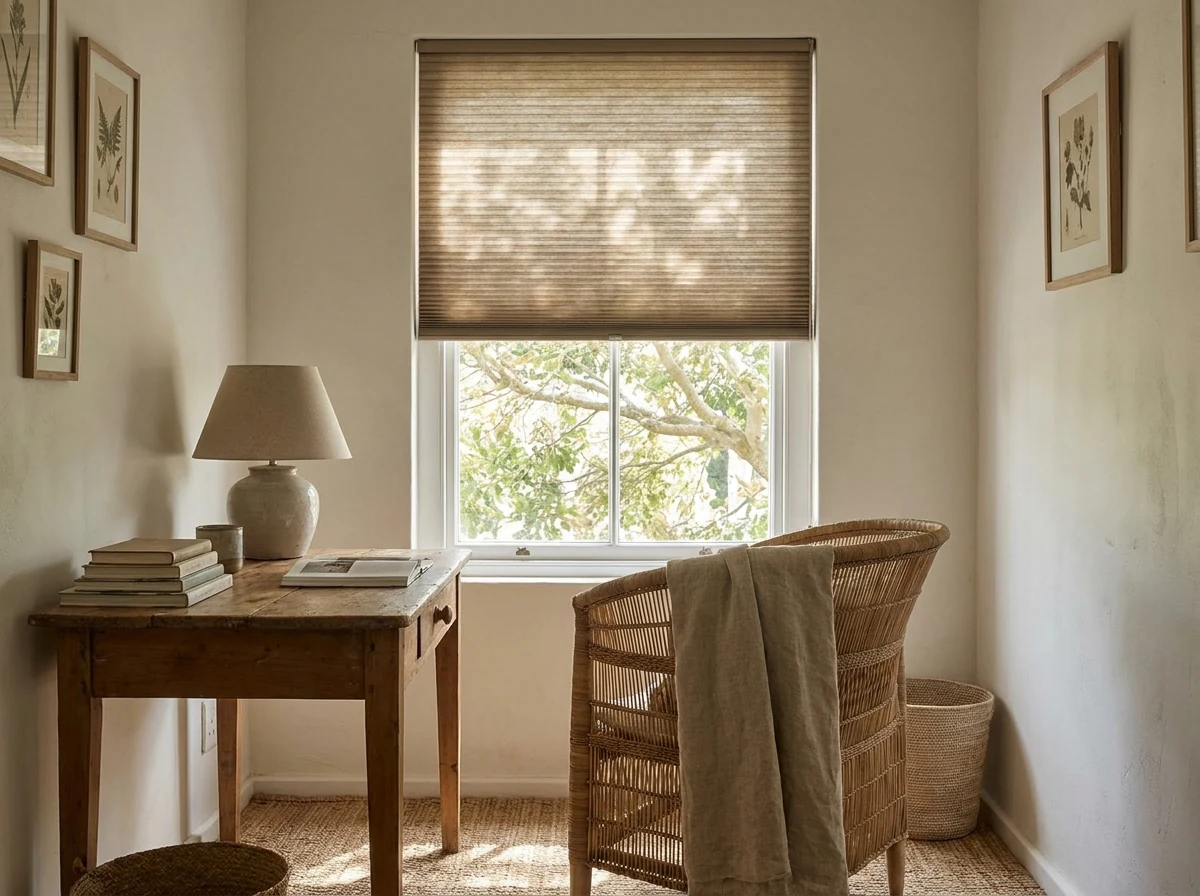
Cellular honeycomb blinds wherever the room runs cold. The pleats enclose pockets of air, and air that cannot circulate is a poor conductor of heat. Drawn over single glazing on a wet, windy August night, one of these is the difference between a room the family sits in and a room they shut the door on.
Something you can work from the chair. If a blind is going to be nudged twenty times in a morning as the light moves on the water, a motor stops being an indulgence. It becomes the difference between a blind that gets adjusted and one that stays exactly where somebody left it on Tuesday.
Cells seen edge-on in an Eastcliff room — the trapped air is the product; the fabric only holds it against the glass.Nine
The five things only a measure settles
A map, a calendar and a little trigonometry got us this far. The five below cannot be reached that way at all, which is why the measure is free, slow, and done with a tape rather than a brochure.
How much sky and how much water each window actually sees. Two windows on the same wall, one with a neighbour's roofline in front of it, have completely different briefs. This is walked, not estimated.
What is actually behind the plaster. Fixing into old solid brick, into a cavity, into later timber framing or into a boarded parapet are four different jobs — and one of those answers means nothing external goes up on that wall at all.
How deep and how square each opening really is. Old buildings settle and new ones are not always true. A centimetre decides whether the blind sits inside the opening or over the front of it, and those two look nothing alike once they are up.
How exposed this particular elevation is. Not the town's exposure, yours: a Sandbaai patio behind a hedge and a Voëlklip deck on the cliff edge are different wind jobs with the same postal code.
Power, permission and who else has a say. Where the nearest usable power point actually is, how a battery-driven tube would get recharged on a double-volume window, and whether an estate committee or the heritage authority wants sight of anything that will show from the street.
Every one of them is a small question on the day and an expensive one six weeks later. That is the whole argument for doing this in person.
Next step
Have the rest of this conversation at your own window
Tell us which walls face where and which room is the problem, and one of our expert consultants will contact you shortly to arrange a free in-home measure with fabric and slat samples, followed by a written per-window quote.
1Free in-home measure — no cost, no obligation.
2Written quote, itemised per window.
3Made to order and professionally fitted.
Sources
Where the checkable parts come from
Facts and figures above trace to these. The solar arithmetic in section one is our own working from the published latitude and is labelled as such; the fabric and product opinions throughout are ours, not findings.
Wikipedia — Hermanus (position on Walker Bay in the Overberg, coordinates near 34.4°S used in our solar working, the Cliff Path and Fernkloof Nature Reserve, and the town's reputation for land-based southern right whale watching between roughly June and December).
Wikipedia — Old Harbour Museum, Hermanus (the Old Harbour was declared a national monument in 1970 and now carries provincial heritage protection).
SAFLII — National Heritage Resources Act 25 of 1999, section 34 (no person may alter or demolish any structure, or part of a structure, older than 60 years without a permit from the provincial heritage resources authority).
Wikipedia — Southern right whale (the species' winter and spring migration to sheltered South African bays to calve, which is the season described in section eight).
South African Weather Service — climate and weather information (the winter-rainfall pattern and the summer south-easterly / winter north-westerly regime of the south-western Cape referred to throughout).
Nothing on this page is a heritage-approval opinion, an engineering assessment or a wind-load calculation for your building. Those belong to Heritage Western Cape, your local authority and a suitably qualified professional. The advice here is given free and without obligation.